AI • ProductStrategy • DeveloperTools
Claude Design and the Rise of Full-Stack AI Products
For most of the generative AI boom, the central question was straightforward.
Which lab had the smartest model.
That question still matters. But it is no longer the only one, and maybe not even the most important one.
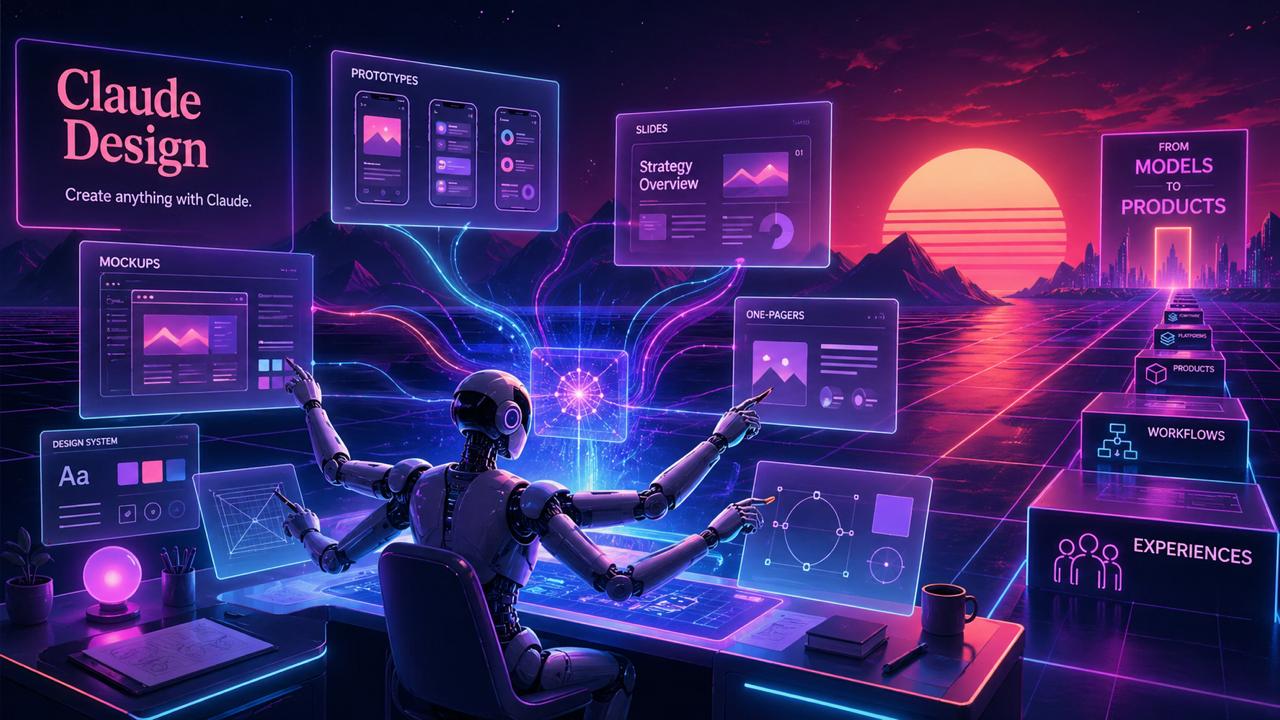
Last week, Anthropic introduced Claude Design, a new Anthropic Labs product that lets users create visual work like mockups, prototypes, slides, and one-pagers directly through Claude. On the surface, this looks like a natural product extension. In reality, it may signal something larger: leading AI companies are no longer content to be model vendors. They want to become full-stack product companies.
That is a major shift.
If this direction holds, the next phase of AI competition will not just be about who has the best model. It will be about who owns more of the workflow between the first idea and the finished output.
Why Claude Design Matters
The obvious story is that Anthropic launched a design-oriented product.
But that framing is too small.
What makes Claude Design interesting is not simply that it can generate visual assets. It is that Anthropic is moving up the stack from assistant behavior into a more opinionated product workflow.
Instead of only helping users think, write, or code, Claude is now being positioned as a tool that can help shape the actual artifacts of product work:
- interface mockups
- interactive prototypes
- pitch decks
- marketing materials
- one-page visual documents
That matters because these are not side tasks. They sit in the messy middle of how modern teams operate.
A lot of product work happens between disciplines. A founder wants to explain a feature. A PM wants to sketch a flow. A marketer wants a rough campaign asset. A developer wants something concrete enough to implement. A designer wants a faster starting point, not a blank canvas.
Claude Design is clearly aimed at that middle layer.
This Is Bigger Than a Design Tool
I do not think the most important question is whether Claude Design will beat Figma, Canva, or other specialized tools head-on.
The more interesting question is what this launch says about AI product strategy.
For the last two years, many frontier labs have behaved like model platforms with chatbot interfaces attached. The model was the product, and everything else was a thin wrapper.
That model is breaking down.
Now the frontier players are being pulled toward something more ambitious:
- deeper workflow ownership
- more vertical experiences
- more structured output types
- more context-specific interfaces
- tighter handoff between ideation and execution
Claude Design fits that trend perfectly.
It suggests Anthropic sees an opening to turn Claude from a general-purpose assistant into a product surface that is useful for specific, valuable jobs.
That is how software categories get real.
The New Battleground Is Workflow, Not Just Intelligence
This is the same pattern we are starting to see across AI more broadly.
A smarter model is helpful, but users rarely experience intelligence in the abstract. They experience it through a workflow.
Can it produce a useful first draft. Can it preserve intent. Can it keep context. Can it generate something close enough to real work that I can actually move faster. Can it reduce switching costs between idea, iteration, and execution.
That is why launches like Claude Design matter more than another benchmark chart.
Benchmarks tell you something about capability. Workflows tell you whether people will actually build habits around the product.
And habit is where durable value lives.
If Claude can help a team go from a vague concept to a presentable artifact without bouncing across five tools and three people, that is not just convenience. That is product leverage.
Why Anthropic Is Making This Move Now
The timing makes sense.
Anthropic is under pressure to define itself not only as a frontier lab, but as a company with a clearer product shape. Claude has earned a reputation for strong writing, coding support, and thoughtful interaction design. The next logical step is to package those strengths into workflows that feel more concrete and more defensible.
A launch like Claude Design does a few useful things for Anthropic at once:
1. It expands Claude beyond chat
This is important.
The chatbot interface was a necessary starting point, but it is not the final form of AI products. As soon as models become good enough, users want them embedded into work patterns, not trapped in a conversational box.
Claude Design is an example of that escape.
2. It reaches adjacent buyers and users
Anthropic has already been strong with technical users. A design-oriented product opens the door to:
- product managers
- founders
- marketing teams
- creative leads
- early-stage teams without full design capacity
That broadens the relevance of Claude without abandoning the company’s existing strengths.
3. It creates stronger end-to-end value
A lab that only provides a model risks commoditization over time.
A company that owns more of the workflow can justify:
- stronger user retention
- higher pricing power
- clearer differentiation
- richer feedback loops from real usage
That is a far more durable position.
What This Means for Designers, Developers, and Product Teams
I think the impact here will be uneven, but meaningful.
For designers, tools like Claude Design will probably be most useful as accelerators, not replacements. The real value is likely to be:
- getting to a first direction faster
- exploring variants quickly
- generating rough assets for internal discussion
- helping non-designers express intent more clearly
For developers, the more interesting angle is handoff.
If AI tools can help turn fuzzy product ideas into structured mockups or interactive prototypes, implementation gets easier. The distance between concept and code shrinks. That does not remove engineering judgment, but it can reduce ambiguity.
For product teams, this could be a major unlock.
A lot of work slows down because early-stage ideas are hard to communicate. If a PM or founder can produce something visual and coherent in minutes, more conversations start with substance rather than guesswork.
That can speed up alignment even when the generated result is imperfect.
The Competitive Signal Is Hard to Ignore
This launch also says something important about the broader AI market.
The category is no longer sorting itself into neat boxes like:
- model company
- productivity app
- design tool
- coding assistant
Those boundaries are collapsing.
AI vendors are increasingly trying to own complete slices of work. In one direction, design tools are adding AI. In the other, AI labs are adding design workflows. The same thing is happening in coding, research, enterprise automation, and content production.
That creates a much more crowded and interesting competitive landscape.
The winners may not be the companies with the single best model. They may be the ones that best combine:
- capability
- interface design
- workflow fit
- team collaboration
- speed to useful output
That is a harder challenge, but a much more meaningful one.
My Take: This Is the Right Move, With Familiar Risks
On balance, I think this is a smart launch.
Anthropic is right to move beyond pure assistant positioning and into more specific product experiences. If the AI market is maturing, that is exactly what strong companies should be doing.
But the risks are familiar.
A workflow product is harder to get right than a general chat interface. Users judge it by practical outcomes, not by demo quality. A design workflow has to feel reliable, editable, and close enough to production reality that teams trust it.
That means Claude Design will be judged on things like:
- how well it handles iteration
- whether outputs feel generic or useful
- how much control teams really have
- how well it respects brand and product context
- whether it fits into existing collaboration habits
If it solves those well, it could become a meaningful wedge into a broader category.
If it does not, it will be remembered as one more flashy AI layer on top of established tools.
What to Watch Next
Over the next few months, I would watch for five signals.
- whether Anthropic keeps shipping more workflow-specific products around Claude
- whether Claude Design stays a lightweight experiment or becomes a serious product line
- whether OpenAI, Google, and others respond with more verticalized creative tools
- whether design generation gets tied more tightly to coding and implementation workflows
- whether teams adopt these tools for real collaboration, not just rapid demos
If those signals continue, we are going to spend less time talking about AI as a chatbot and more time talking about AI as a production layer inside everyday work.
That would be a much bigger shift than one product launch.
Final Thoughts
Claude Design is interesting not because it proves AI can make pretty mockups.
It is interesting because it shows where the market is heading.
The frontier labs are starting to compete on workflow ownership, not just model intelligence. That changes the shape of the industry. It changes who they are selling to. And it changes how products like Claude will be evaluated going forward.
The next chapter of AI will not be won only by the company with the smartest model.
It will be won by the company that can turn intelligence into something people can actually use to get real work done.
That is the race now.
Thanks for reading. If tools like Claude Design mature quickly, the most valuable AI products of the next year may look a lot less like chatbots and a lot more like work surfaces.